
Pacific Palisades EO1 Fast-Track Permits: What's Actually Going On
Everyone’s talking about the 30-day Pacific Palisades EO1 Fast-Track Permits and fee waivers. Here’s what’s actually happening — the good, the messy, and the stuff nobody warned you about.

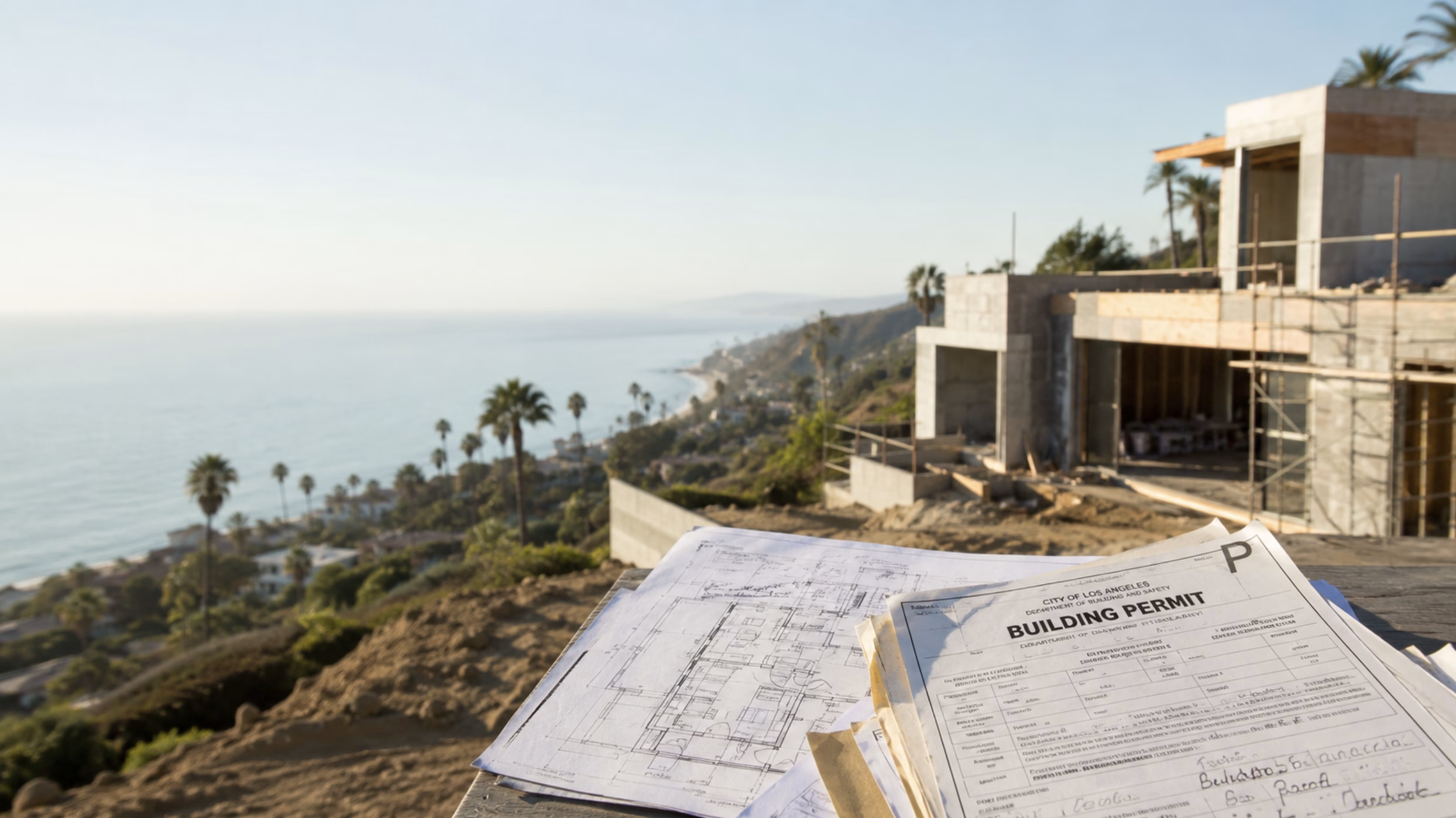
If you’re rebuilding in the Palisades and trying to figure out what Pacific Palisades EO1 fast-track permits actually mean for your project, you’ve probably heard “EO1” a few hundred times by now. Your architect mentions it. Your neighbor across the street swears by it. Someone at the One-Stop Center handed you a flyer about it. And somewhere along the way you nodded like you knew what it meant and then quietly looked it up that night.
Don’t feel bad. Most of our clients did the same thing.
EO1 is genuinely a big deal. It’s also the most oversold, oversimplified, and misunderstood thing happening in the Palisades rebuild right now. The headlines say “30-day permits.” Reality is messier. The fee waivers are real, but they don’t cover what you think. The Coastal Commission stuff is actually amazing — but only for certain projects.
So let’s just talk through it like adults. By the end of this, you’ll know what Pacific Palisades EO1 fast-track permits actually mean for your rebuild, what they’ll do, what they won’t do, and whether your project even qualifies.

So What Is EO1, and How Do Pacific Palisades EO1 Fast-Track Permits Actually Work?
Executive Order #1. Signed by Mayor Bass on January 13, 2025 — six days after the fire started. Probably the most aggressive permit-streamlining policy LA has ever rolled out, and it exists for one reason: get Palisades homeowners back into their homes faster.
Here’s what it does, in plain English:
It forces the city to review your permit in 30 days if your project is a like-for-like rebuild. They either issue it or send you corrections within 30 calendar days. No more sitting in a queue for six months.
It waives a huge chunk of city fees. Plan check, building permit, plumbing, electrical, mechanical — gone. For most of our clients, this saves somewhere between forty and eighty grand. Not nothing.
It fast-tracks the Coastal Development Permit (CDP). This is the one most people don’t appreciate. Pre-fire, getting a CDP in the Palisades could add a year to your project, sometimes more. EO1 either skips it entirely or shortens it to a few weeks for most qualifying rebuilds. Honestly this might be the most valuable piece of the whole order.
It lets you build up to 110% of what you had. So if your old place was 2,800 square feet, you can go up to 3,080 and still qualify. Push past that and you trigger full review.
It speeds up debris removal coordination with the Army Corps. Not a huge factor for most homeowners — the Army Corps was already working fast — but it doesn’t hurt.
The order’s in effect indefinitely, though everyone expects a sunset review in 2027 or 2028.
About That 30-Day Permit Thing
The 30-day promise is a real policy. It just isn’t really happening in 30 days.
In the real world, in 2026, the average Palisades permit under EO1 takes more like 45-55 days from submittal to issuance. Some come in faster. We have a 3,000 sq ft Mediterranean rebuild that got approved in 41 days, which is about as close to the promise as anyone’s getting consistently. Most projects land in the 45-60 day range. A few drag out to 70-80 days when corrections pile up.
Why?
Two reasons. First, LADBS staffing didn’t magically expand to match the volume of fire submittals. The fast-track process exists on paper. The humans processing the paperwork are still humans working a normal day.
Second — and this is the bigger one — almost every submittal comes back with corrections. You submit, the city reviews, they send back comments, you fix them, you resubmit. Each cycle technically resets the 30-day clock. So a project that “took 30 days” in city-review-time often actually took 60-75 days on the calendar.

This isn’t a scam. It’s just how reality works versus how press releases work.
Here’s the honest framing: EO1 cuts permit timelines by about 80% compared to the old process. That’s transformative. Just don’t promise your insurance company a move-in date based on a 30-day permit timeline. You’ll regret it.
What Actually Qualifies?
This is where most of the questions come from, so let me lay it out clearly.
The full EO1 benefits kick in when:
You’re rebuilding on the same lot. No mergers, no subdivisions, no boundary changes.
You’re rebuilding the same kind of home. Single-family stays single-family. Converting your old house into a duplex disqualifies you.
You’re staying within 110% of the original square footage. Hit 111% and you trigger full discretionary review. Yes, 1% matters that much. Architects sometimes design to 112% without realizing they crossed the line, so calculate carefully.
You’re staying within roughly the original footprint. Major expansions outside the original buildable area trigger more scrutiny even if your total square footage is fine.
You’re not adding a story. Going from single-story to two-story almost always disqualifies you. There are some exceptions on hillside lots where the second story was effectively present before — talk to an architect who knows the difference.
You don’t need any new variances. If your project needs a setback variance, height variance, or any other discretionary approval, EO1 doesn’t help you with that piece.
Can I change anything about the design?
Absolutely. You can update the layout, swap the roof style, change the windows, add solar, modernize the kitchen, redo all the finishes. None of that affects EO1 qualification.
What matters is the exterior envelope. Footprint, height, scale, use. Stay close on those four things and you’re fine.
The Fee Waiver Money

This is the part where homeowners get excited and then sometimes confused. Let me break down what’s actually waived and what’s not.
What you don’t have to pay anymore:
City plan review fees. Building permit fees. Plumbing, electrical, and mechanical permit fees when they’re part of the main rebuild. Most Bureau of Engineering fees. Coastal Development Permit fees if your project needs one. School district fees on like-for-like rebuilds.
For a typical 3,000 sq ft Palisades rebuild, this saves somewhere between $45,000 and $65,000. Bigger or more complex projects can easily save over $100,000.
What you still have to pay:
Outside utility fees. LADWP, gas company, cable. These aren’t city fees so they’re not waived.
Sewer connection if your line needs replacement. Sewer is its own thing.
Encroachment permits if your work touches the public right-of-way (think: driveway aprons, sidewalks).
All your professional fees. Architect, structural engineer, soils consultant, surveyor. EO1 saves you city money, not professional money.
Soft costs. Insurance, project management, temporary housing.
Electrical service upgrades from SCE.
So when someone tells you EO1 “covers your permit fees,” they’re right — but the savings are about the city portion, not every fee in the project budget. Make sure your contractor and architect itemize the EO1 savings clearly so you can actually see what you’re getting.
The Coastal Commission Piece (This Is the Big One)
Okay this is the part I get genuinely excited about.
Most of the Palisades sits in the California Coastal Zone. Pre-fire, building anything new in that zone required a Coastal Development Permit — a process that could add 6 to 18 months and sometimes required Coastal Commission hearings, environmental reports, the whole circus.
Under EO1, qualifying rebuilds get one of two treatments:
If your rebuild is clean like-for-like — same footprint, same height, nothing weird with the site — you can get a categorical exemption. You skip the CDP process entirely. This is the magic outcome.
If you’ve made modest modifications but you’re still within EO1’s parameters, you get an expedited CDP review. Instead of 6-18 months, you’re looking at 4-8 weeks.
Think about what this means. The thing that used to be the single biggest timeline-killer on Palisades rebuilds — Coastal Commission review — is mostly off the table now for qualifying projects.
What knocks you out of the coastal fast-track:
Building closer to a bluff or beach edge than your original home was. Coastal Commission cares deeply about bluff setbacks.
New construction in environmentally sensitive areas.
Significant grading changes beyond what your foundation work actually requires.
New accessory structures in setback areas.
Pools — relocating an existing pool, or adding a new one in certain locations.
If you qualify for the coastal piece, your rebuild gets dramatically simpler. If you don’t qualify, you’re back in standard CDP land and your timeline gets long again.
What Will Disqualify Your Project
I keep mentioning what qualifies. Let me just list the deal-breakers in one place.
Going over 110% original square footage. Even a little.
Adding a story.
Expanding the footprint outside the original buildable area.
Changing the use (single-family to duplex, primary house to short-term rental compound, etc.).
Merging your lot with a neighbor’s. Subdividing your lot.
Needing any variances. Setback, height, density — anything discretionary.
Doing significant hillside modifications. The Palisades has hillside overlay regulations on top of everything else, and substantial slope work can disqualify you even if the house itself is EO1-compliant.
Being outside the official Palisades Fire boundary. EO1 is geographically specific.
If you’re in a gray area on any of these, get a pre-submittal consultation with the Palisades One-Stop Rebuilding Center. Don’t spend three months designing something that won’t qualify. We’ve watched homeowners do this and it’s painful.

How the Process Actually Goes
Here’s what the whole rebuild looks like, start to finish:
Debris removal first. Army Corps of Engineers handles this on most lots. EO1 expedites coordination but it still takes 2-4 months in most cases. Then you need lot certification confirming the site is clear.
Soils report and foundation assessment. A geotech engineer figures out if your existing foundation can be reused or if you need new. Foundation reuse can save real money but requires testing. Allow 4-6 weeks.
Architectural design. Your architect designs to EO1 parameters. This is where most homeowners spend the most time emotionally — working through what they want versus what’ll qualify. Usually 6-12 weeks of back-and-forth.
Plan check submittal. Architect submits through the Palisades One-Stop Rebuilding Center. The 30-day clock starts here.
City review. Plans get reviewed. Almost everyone gets at least one round of corrections. Each round technically restarts the clock. Realistic city review time: 30-60 days total.
Coastal review if applicable. Runs in parallel with LADBS for most projects. 4-8 weeks under expedited CDP.
Permit issues. Once the dust settles, you get your permit and you can break ground immediately.
Construction. Typical Palisades rebuild takes 8-14 months once permitted. EO1 doesn’t speed up construction — only the permit work that precedes it.
Total realistic timeline from fire to move-in for qualifying projects: 14-22 months. Compare that to 24-36+ months for non-qualifying or non-fast-tracked rebuilds and you can see why people care so much about this order.
The Mistakes That Cost People Weeks
Most of the time when EO1 timelines blow up, it’s because of submittal mistakes. The same ones, over and over:
Incomplete submittals. Missing structural details, missing energy documents, missing the soils report. Each missing piece adds a correction round.
Plans not explicitly tagged as EO1. Sometimes the architect forgets to mark it clearly and the submittal gets routed to the standard queue. Verify your submittal is labeled for EO1 fast-track.
Square footage miscalculation. Honestly, this is the most common one. People design to 112% thinking they’re fine. They’re not.
Foundation reuse without proper documentation. If you’re reusing the old foundation, you need petrographic testing and a structural engineer certifying it’s intact. Skipping this delays everything.
Missing WUI compliance documentation. Every Palisades rebuild has to meet Chapter 7A fire-resistant construction. Plans without explicit WUI assemblies labeled get bounced.
Insurance documentation gaps. Some EO1 benefits require proof of pre-fire property condition. Missing paperwork slows approval.
A well-prepared submittal hits the 30-50 day timeline realistically. A sloppy submittal hits 70-100 days. The difference is entirely in preparation.
Stuff You Still Have to Do, Even Under EO1
EO1 fast-tracks the review. It doesn’t waive any actual building code requirements. Your rebuild still has to meet:
Chapter 7A WUI compliance. All exterior assemblies — roof, eaves, vents, exterior walls, windows, decks. Non-negotiable in the fire zone.
Title 24 energy code. California’s the strictest in the country. Most new homes need all-electric design, heat pumps, solar PV, often battery storage.
Modern structural code. Including seismic requirements that may be stricter than what your original house met.
Current plumbing, electrical, and mechanical codes. Your new home is built to 2026 standards, not 1985 standards.
Hillside compliance if you’re on a slope. Drainage, retaining walls, slope analysis.
None of this is an EO1 obstacle. It’s just code. The fast-track gets you through the permit faster — it doesn’t get you around the code.
Is EO1 Always the Right Move?
For most Palisades fire victims rebuilding within EO1’s parameters, yeah, use it. The money savings and timeline acceleration are real and significant.
But there are situations where skipping it makes sense:
If you want to build something meaningfully different. Bigger house, new story, major footprint changes — you’ll need full discretionary review anyway. Trying to force your dream project into EO1 just to qualify often gives you a worse home that you’ll regret in five years.
If you’re merging lots or changing the use. EO1 doesn’t help, and the standard process exists for these scenarios.
If your insurance situation is complicated. Some insurance settlements work better with longer timelines. Talk to your adjuster before assuming faster is better.
If you’re not in a rush. Some homeowners have decent temporary housing and aren’t desperate to rebuild quickly. If your timeline is flexible and you want maximum design flexibility, the standard process gives you that.
The truth is EO1 is really good at one thing — rebuilding what you had, faster and cheaper. It’s not designed for reinventing your home from scratch. Be honest with yourself about which one you actually want.
How We Handle Pacific Palisades EO1 Fast-Track Permits.
We’ve been actively rebuilding in the Palisades since the fire and we’ve learned the EO1 process from the inside. Some of what we focus on:
We design to EO1 parameters from day one. Most projects that miss the fast-track miss it because the design got ambitious before anyone checked the qualification math. Get the math right first, then design.
We prepare submittals with complete documentation. Soils, structural, energy, WUI, foundation certification — everything on the first submittal. Reduces correction rounds, keeps the clock moving.
We work directly with the Palisades One-Stop Rebuilding Center. The plan checkers there know us, we know them, and that working relationship matters more than people realize.
We don’t promise 30 days. We promise our best work to make EO1 deliver what it can deliver — usually 45-60 days from clean submittal to permit issuance, with the rest of the project running smoothly around it.
If you’re starting your rebuild and want a no-pressure conversation about whether EO1 makes sense for your project, we’re here. Our office is in Altadena, we have active fire rebuild projects in the Palisades, and we cap our active project load at 15 to keep the quality where we want it.

One Last Thing
EO1 is the most important policy you’ll deal with in your Palisades rebuild. It’s also the most oversold. The press talks about 30-day permits. Some contractors promise things EO1 doesn’t actually deliver. And the general optimism around rebuild stories tends to skip the messy details.
Here’s the honest version: it works. It saves real money. It cuts real time. It doesn’t actually deliver 30-day permits in most cases. But it delivers permits in 1/5 to 1/7 the time of the old process, and for most homeowners rebuilding what they had, that’s transformative.
Just go in with realistic expectations, a contractor who’s actually navigated the process, and an architect who knows how to design to the parameters from day one. With those three things in place, Pacific Palisades EO1 fast-track permits will deliver.
Whenever you’re ready to talk through your specific project, we’re here.
Frequently Asked Questions (Real Questions We Hear)
Ready to Start Your home building Project?
You don’t need to have everything figured out before you call us. Whether you’re still fighting with your insurance company, waiting on debris clearance, or ready to break ground tomorrow — we’ll tell you exactly where you stand and what comes next. No pressure. No sales pitch. Just a straight conversation.